
I was reminded recently of a conversation I had with a patient years ago.
He’d seen a consultant and had been told:
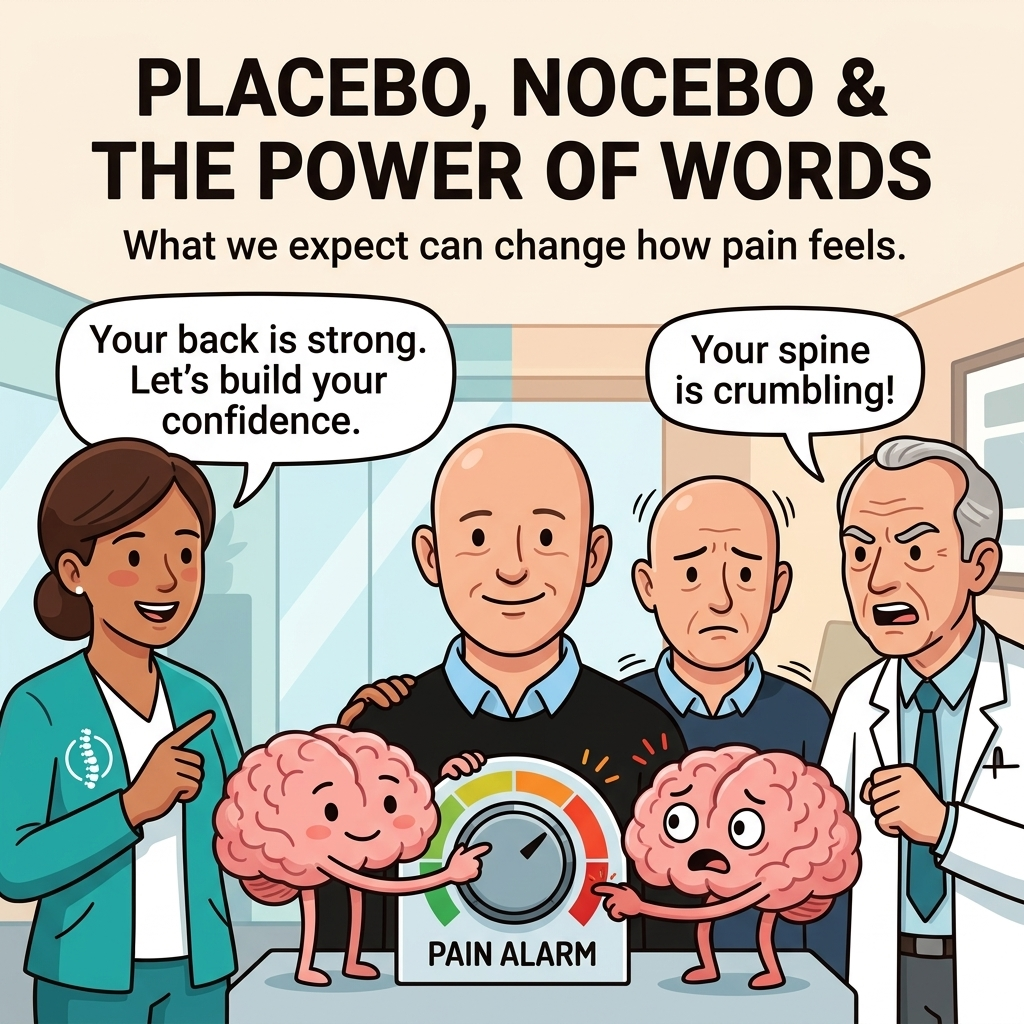
“Your spine is crumbling.”
The poor bloke genuinely thought bits of his back were gradually disintegrating.
I seem to remember replying:
“Why? Is your spine made out of a biscuit?”
I’ve been working on my communication skills since then. 😂
But there’s actually some serious science behind this.
The words we use, what we expect to happen and our previous experiences can all influence how we experience pain.
Welcome to the slightly weird world of placebo and nocebo.
💊 First: placebo doesn’t mean “fake”
When people hear the word placebo, they usually think:
Sugar pill + gullible patient = imaginary improvement.
That’s really not a good description.
A placebo effect is a genuine change in symptoms influenced by things surrounding a treatment — expectation, previous experience, the environment, reassurance and the meaning we attach to what is happening.
And pain is particularly susceptible to this.
A large 2026 study combined brain-imaging data from 409 people across 16 studies looking at placebo pain relief.
Researchers found that expectation and previous conditioning could change both people's pain experience and activity within brain regions involved in processing pain.
So if someone believes:
“This is going to help me.”
…the nervous system may genuinely respond differently.
That doesn't mean they're imagining the pain.
It means the brain isn't simply sitting there waiting for pain signals to arrive.
It's actively interpreting them.
😬 And then there’s placebo’s evil twin…
Nocebo.
If positive expectations can sometimes reduce symptoms, negative expectations can sometimes make them worse.
Imagine being told:
❌ “Your back is worn out.”
❌ “You've got the spine of an 80-year-old.”
❌ “Your discs are crumbling.”
❌ “Never bend forward again.”
❌ “One wrong movement and this could go.”
Suddenly bending over to put your socks on doesn't feel like an ordinary movement anymore.
It feels dangerous.
Your nervous system is now expecting trouble.
And remember what we've discussed throughout our pain series:
The brain loves predicting things.
If it's expecting danger, that expectation can influence what you subsequently experience.
🧠 This doesn't mean we're thinking ourselves into pain
This bit is really important.
If you've broken your ankle, positive thinking isn't going to stick the bone back together.
If you've got inflammation, nerve compression, infection or another medical problem, reassuring language doesn't magically remove it.
Tissue matters.
But pain isn't simply a damage meter.
The nervous system considers information coming from the body alongside previous experience, expectations, context, emotions and whether it believes you're currently in danger.
This means two people with apparently similar injuries can experience very different levels of pain.
And it means the same person can experience different amounts of pain from the same body part on different days.
Pain is real.
It's just considerably more complicated than we once thought.
🗣️ Which means healthcare professionals need to watch our mouths
This is where nocebo becomes especially relevant.
A 2025 paper examining nocebo effects in musculoskeletal pain highlighted several potential sources of negative expectations, including diagnostic labels, imaging findings and the way healthcare professionals explain conditions to patients.
That's quite important.
Imagine having completely ordinary age-related changes on an MRI.
One clinician says:
“There are some changes we'd commonly expect to see at your age. Let's look at whether they're actually relevant to your symptoms and concentrate on getting you moving comfortably again.”
Another says:
“Wow. There's a lot of degeneration in there.”
Same MRI.
Potentially very different message received by the nervous system.
And once somebody starts believing their back is fragile, they may move less, become more fearful of certain movements and pay much more attention to every little sensation coming from their spine.
That's not particularly helpful if our eventual goal is to get them confidently moving again.
😳 Nocebo can even affect treatment side effects
Here's another fascinating example.
In a clinical trial involving people with chronic musculoskeletal pain, people with stronger negative expectations about treatment experienced less improvement in pain and reported more unwanted side effects.
Again, they weren't making those symptoms up.
Expectation can influence attention, anxiety and nervous-system processing.
Your brain receives the warning:
“Watch out for this.”
So it watches.
Very closely.
It's rather like buying a particular car and suddenly seeing the same model everywhere.
They haven't magically appeared overnight.
Your brain has simply decided they're important.
👨⚕️ So should doctors simply tell everyone everything is wonderful?
Absolutely not.
That's not the answer either.
Healthcare professionals have a responsibility to explain genuine problems, risks and treatment options truthfully.
If something is serious, patients need to know.
The challenge is:
How do we communicate accurately without unnecessarily frightening somebody?
A 2026 review looked at 38 studies investigating ways healthcare communication could reduce nocebo effects.
Approaches including careful framing of information, education about nocebo, reassuring wording and empathetic communication showed promise for changing expectations and perceived threat — although the researchers also emphasised that more real-world clinical evidence is needed.
So this isn't about pretending everything is fine.
It's about choosing accurate language.
Instead of:
“Your spine is worn out.”
Perhaps:
“Your scan shows some age-related changes. They're very common, so let's work out which findings are actually relevant to you.”
Instead of:
“Don't bend — you'll damage it.”
Perhaps:
“That's sensitive at the moment, so we'll gradually build your confidence with that movement.”
Very different message.
👐 What does this have to do with chiropractic?
Quite a lot, actually.
As chiropractors, what we say during an examination and treatment matters alongside what we do.
If every appointment reinforces the idea that:
“Your back keeps going out and only I can put it back in…”
…we probably shouldn't be surprised if someone eventually becomes frightened of moving without us.
That isn't the message we want at Derby Family Chiropractic.
Our aim should be to help people understand what's happening, address appropriate physical problems and gradually become more confident in their bodies — not less.
Sometimes treatment might involve hands-on care.
Sometimes exercise.
Sometimes changing how somebody moves.
And sometimes one of the most useful things we can do is explain:
“Your body isn't as fragile as you've been led to believe.”
🧠 The takeaway
Placebo and nocebo don't mean:
“It's all in your head.”
They demonstrate something considerably more interesting.
Expectation, experience and context can genuinely influence how the nervous system responds.
So the language we use matters.
The explanations patients receive matter.
And making somebody frightened of their own spine probably isn't particularly clever.
Which takes me back to the gentleman whose spine was apparently crumbling…
Thankfully, twenty years later, I've developed a considerably more professional response.
Although I still maintain that unless you're made from Rich Tea biscuits, your spine probably isn't crumbling. 😂
📚 Research
Spisak T et al. (2026). Meta-analytic evidence for distinct neural correlates of conditioned versus verbally induced placebo analgesia. Nature Communications.
Lluch-Girbés E et al. (2025). Negative expectations and related nocebo effects in shoulder pain: a perspective for clinicians and researchers. Pain Management.
Lin Y-M et al. (2026). Shaping expectations in care: A scoping review of experimental and clinical evidence on communication strategies to reduce the nocebo effect.